BLUE TECH RADARTechnologies that are transforming the sea.
SAFEBOAT brings artificial intelligence and predictive monitoring on board
Developed in Santa Catarina, Brazil, the technology integrates sensors, telemetry, maintenance records, NMEA and artificial intelligence to follow the boat around the clock, showing how data and connectivity are creating a new generation of solutions for the nautical industry.
August 2026
What if you could ask over WhatsApp how your boat is doing and get an answer based, at that very moment, on the batteries, engines, sensors, position and maintenance history of the vessel?
That idea, which a few years ago might have seemed far from the reality of boating, is already arriving on board.
Developed in Santa Catarina, Brazil, SAFEBOAT has created a platform bringing together hardware, sensors, connectivity, an app and artificial intelligence to turn the many pieces of information produced inside a vessel into data that can help owners, fleet managers, marinas and other professionals in the sector.
It is one more example of a shift gaining ground worldwide: the boat is ceasing to be only a machine for navigating and is becoming a connected data platform as well.
The boat in the palm of your hand
The concept starts with a unit installed on board. SAFEBOAT Central connects the vessel’s sensors and systems and transmits the information to the cloud. From there, the data can be followed through the app, even when the owner or manager is far from the boat.
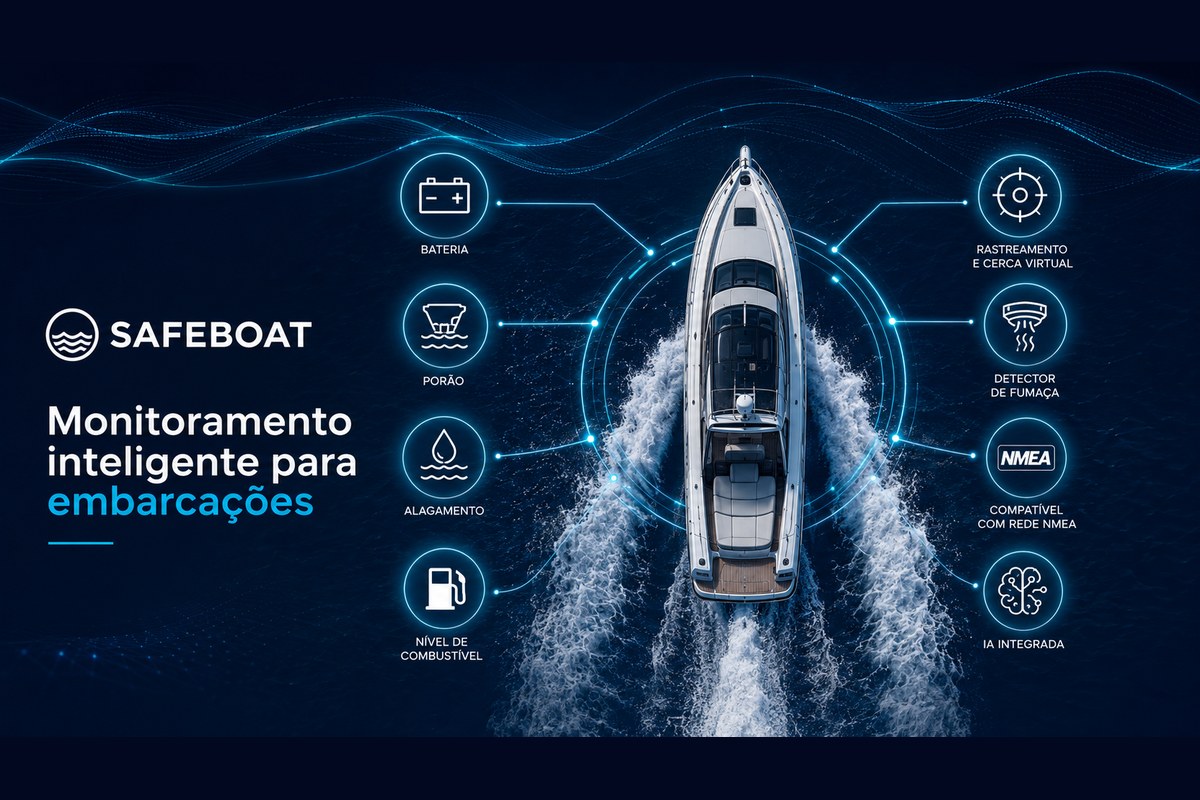
Among the information that can be monitored are voltage and consumption of the battery banks, bilge pump activations, presence of water, engine room temperature and humidity, vessel position, speed and tank levels.
On the engines, the system can access information such as hour meter, revolutions, oil pressure and temperature, coolant temperature, fuel pressure and consumption, depending on the integration available on the vessel.
So it is not only about knowing where the boat is. The aim is to start understanding how it is.
From monitoring to predictive maintenance
This is precisely where one of the most important changes brought by digitalisation lies.
Traditionally, much of a vessel’s maintenance happens in two ways: at predetermined intervals, or after a problem appears.
Connected systems open a third possibility: using the data continuously produced by the vessel itself to identify changes in behaviour and act before a given problem results in downtime.
SAFEBOAT also organises the history of services carried out. Engine, electrical, generator and safety equipment overhauls and other work can be recorded with date and hour meter, allowing the system to issue alerts before the next due dates.
The information no longer sits only in a spreadsheet, a note or the memory of whoever looks after the boat. It becomes part of that vessel’s own digital history.
NMEA connects what is already on board
Another relevant aspect of the solution is integration. The platform is compatible with NMEA 2000 and J1939, allowing access to information already produced by the instrumentation and engines existing on certain vessels. The company also offers readers and converters to bring engine data onto the NMEA network.
This interoperability is an increasingly important question for the industry. The future of the connected boat depends not only on creating new equipment, but on the ability of different electronic systems to talk to each other.
Sensors, engines, displays, navigation, electrical systems, communication, automation and software are beginning to form a single information ecosystem.
And now artificial intelligence enters
The most recent development presented by the company adds artificial intelligence to the platform.
SAFEBOAT AI uses sensor information, maintenance records and vessel data to provide diagnostics in plain language. According to the company, the user can even check the boat’s status over WhatsApp and receive a summary of conditions such as batteries, bilge pump, communication, position and pending maintenance.
It is an interesting application of artificial intelligence because it stops working only on information entered manually by the user. It starts interpreting data produced by the physical asset itself.
The boat literally begins to answer about its own condition.
Eyes inside the vessel
Connectivity has reached images too. SAFEBOAT offers infrared cameras integrated into the app, making it possible to follow spaces such as the cabin, cockpit and engine room, including at night.
And development continues. Among the solutions the company says are under development are sensors for predictive vibration analysis, able to identify changes related to misalignment, play and wear, and thermal cameras combined with artificial intelligence to follow hot spots and overheating situations inside the engine room.
These developments help show where an important part of the nautical industry may head in the coming years.
The boat starts generating value through data
The digital transformation of vessels creates possibilities that go beyond the owner. The same data infrastructure can have applications for shipyards, marinas, fleet managers, charter, boat sharing, maintenance and insurers.
For a marina or a company responsible for dozens of boats, for example, a centralised dashboard can allow different vessels to be followed and pending alerts or overhauls to be identified in a single interface. SAFEBOAT offers precisely a solution aimed at operations of this kind.
For maintenance, historical data can help identify recurring failures. For the shipyard, connectivity may come to be part of the electronic architecture of new models.
And for insurers, objective information related to maintenance, telemetry and the occurrence of certain events can open new discussions about risk management. SAFEBOAT itself already presents specific applications of the platform aimed at that market.
A new technology chain is entering the nautical sector
This is exactly why a solution like SAFEBOAT interests Blue Tech Radar. It shows that contemporary nautical innovation is not necessarily in a new hull or a new engine. It can be in a small electronic unit installed inside the boat.
Around it a whole chain emerges: sensors, IoT, artificial intelligence, cloud computing, apps, telemetry, communication, electronic protocols, cybersecurity, cameras, data analysis, predictive maintenance and automation.
These are technology companies that a few years ago might not even have seen themselves as part of the nautical industry. Today they are becoming essential to its development.
Where technology meets the Ocean Economy
It is this new ecosystem that Blue Nautical Hub Brasil wants to follow and bring closer.
Blue Tech Radar was created to present Brazilian and international technologies capable of transforming the nautical industry and the different segments of the Ocean Economy.
Robotics, artificial intelligence, drones, sensors, electronics, software, new materials, autonomous systems, electrification, connectivity, environmental technologies and digital solutions will be increasingly present in the relationship between industry and ocean.
SAFEBOAT represents exactly one of these transformations: bringing intelligence inside the vessel and turning what happens on board into usable information.
And perhaps this is one of the biggest changes of the next generation of boats. Navigating will not be enough. They will also be increasingly prepared to monitor, record, learn, alert and communicate.
Blue Nautical Hub Brasil feature, with information from SAFEBOAT. Illustration: Blue Nautical Hub Brasil.