BLUE TECH RADARTechnologies that are transforming the sea.
PMP Italia brings electrification and high capacity to moving vessels ashore
Electric and electro-hydraulic machines already move vessels of up to 40 tonnes, with remote control, electronic diagnostics and solutions built to reduce the dependence on tractors and large machinery inside marinas and shipyards.
August 2026
When people talk about innovation in the nautical sector, attention usually turns to what is inside the boat: electric propulsion, new materials, navigation systems, artificial intelligence and automation. But there is a technological revolution happening ashore too, behind the scenes of marinas and shipyards.
That is exactly where the Italian company PMP Italia operates. It is a manufacturer specialised in developing handling and transport equipment for the nautical, aeronautical and industrial sectors. Based in Dairago, in Lombardy, the company has been in business since 1980 and has directed a significant part of its engineering towards electric systems able to move loads that reach dozens of tonnes.
In the nautical field the proposal is particularly interesting: replacing or complementing tractors, forklifts and other conventional equipment with compact machines designed specifically to move boats, trailers and cradles inside spaces where precision and manoeuvrability matter as much as raw force.
From 5 to 40 tonnes: how the Formula line evolved
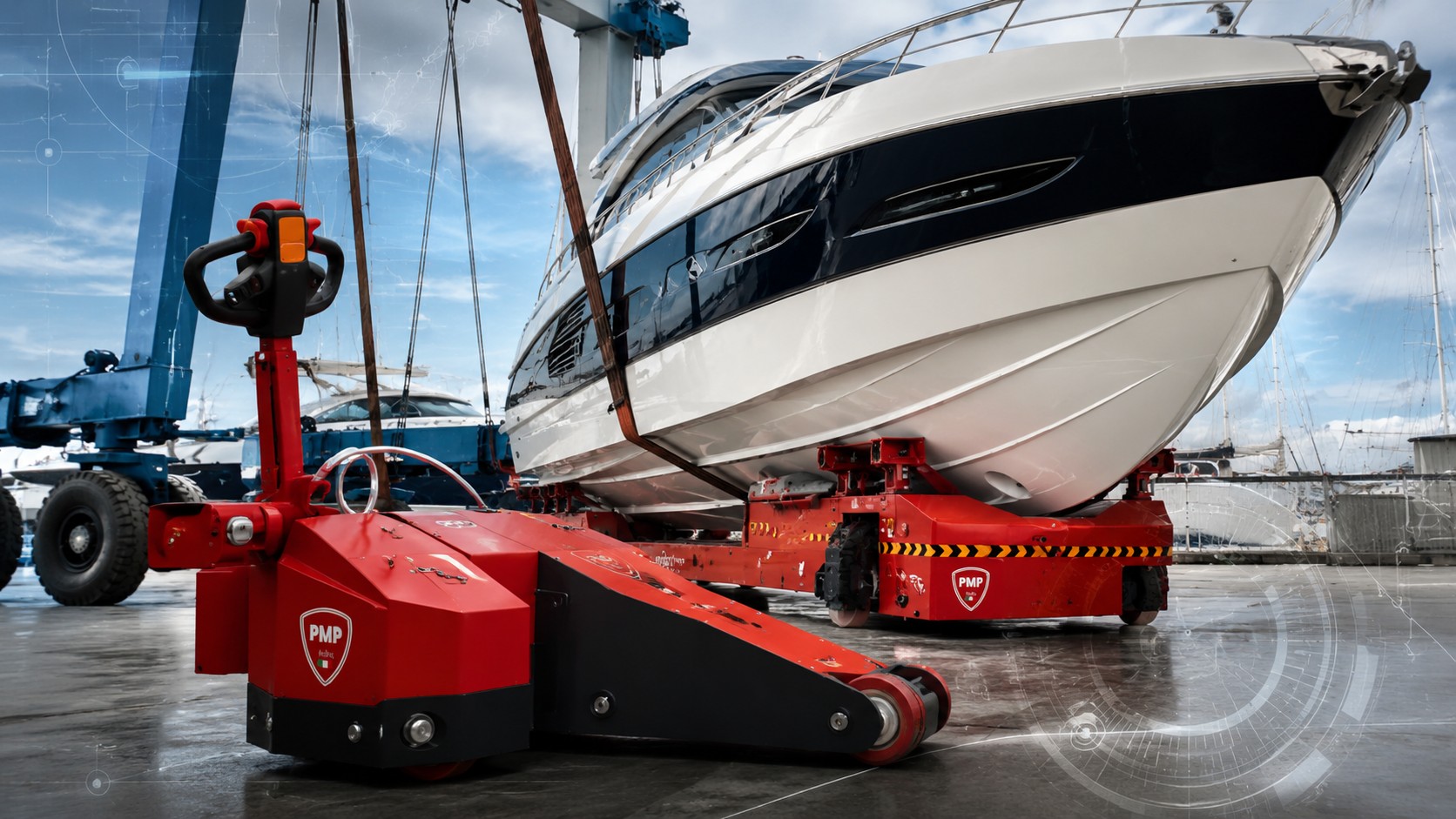
Among the solutions that draw the most attention is the Formula family, made up of electro-hydraulic movers that combine electric traction with hydraulic systems to lift and shift the structures supporting the vessels.
The principle is relatively simple but technologically efficient: the machine goes under the support point of the cradle or trailer, takes part of the load through a hydraulic arm and uses its own electric traction to carry out the movement.
The Formula 3 uses a 300 bar electro-hydraulic pump and electronics with a diagnostic system, with a declared capacity to move up to five tonnes. On the Formula 2 the capacity rises to ten tonnes, with a 2 kW motor and an arm able to lift three tonnes. The Formula 1 enters another operational category: a lifting arm rated at ten tonnes and towing capacity of up to 20 tonnes.
But it is mainly the T30 and T40 versions that show how far this technology has come.
Forty tonnes commanded from a distance
The Formula 1 T30 uses two 2,000 W electric motors and has a towing capacity of up to 30 tonnes. Besides the 300 bar electro-hydraulic system, it incorporates electronic steering, diagnostic systems and a remote control which, according to the manufacturer, can operate the machine from up to 80 metres away.
On the T40 the architecture is even more robust. There are two electric motors of 2,500 W and 48 V, a hydraulic arm with a lifting capacity of 12 tonnes and a declared towing capacity of up to 40 tonnes. The model also uses electronic steering and radio control with a stated range of up to 80 metres.
The remote control should not be seen only as a convenience. In an operation moving large vessels, it lets the operator choose a position with a better field of view, watching the boat, the cradle, obstacles and the machine's path at the same time. That is an important shift from the traditional logic of an operator necessarily sitting on a tractor or a large piece of equipment.
Technology also means safety
There is another important point in this evolution: electrification is not the only technological element present in these machines.
Across the different versions there are features such as electronic controls with fault diagnostics, electric brakes, emergency shutdown systems, battery charge indicators and anti-crushing protection devices. The T30 and T40 versions add electronic steering and radio control.
That combination shows a transformation starting to reach nautical infrastructure: the machine stops being only a source of force and starts to incorporate sensors, electronic control and auxiliary safety systems.
It is not only about big boats
PMP's strategy is interesting because it does not start at 40 tonnes. The manufacturer has a broad family of smaller machines for moving trailers and vessels inside marinas, yards and shipyards. The current nautical catalogue includes the Micro Tug, Mini Tug, MTPlus, TC 500, TC 1000, Power Tug 4WD, the Formula 1, 2 and 3, the T30 and T40, the Jet Ski Tug and even solutions for beach operations and specific terrain.
The Micro Tug, for instance, is a small 24 V electric mover designed for towing capacities of up to 1,200 kg. The Mini Tug reaches approximately 2,500 kg. At the other end of that category is the MTPlus, which uses a 1,900 W, 48 V brushless electric motor and has a declared towing capacity of 14 tonnes on flat ground. The hydraulic arm takes a load of up to one tonne on the tow ball.
This range matters because it shows that electrification can be applied from the everyday movement of small vessels all the way to operations involving large yachts.
And when even the ground does not help?
Another interesting example in the portfolio is the Tug Amphibious, developed for environments where conventional equipment struggles to operate. The model uses tracks, hydrostatic transmission, a stainless steel structure and components prepared for that kind of setting. The declared towing capacity is four tonnes.
That opens applications on beaches, ramps and areas where sand or uneven ground makes moving vessels more complex. This is precisely where this kind of technology starts to go beyond the concept of a simple electric tug and becomes part of the planning of nautical infrastructure.
The nautical technology that stays ashore
There is a larger consequence behind these machines. A modern marina does not depend only on piers, berths and travel lifts. It depends on a chain of ground movement that has to put boats in the water, take them out, send them for maintenance, reposition vessels and make use of every available metre of the yard.
The larger the vessel, the more complex that logistics becomes. Compact machines able to move large masses can allow new circulation and storage layouts, as well as reduce the need to carry out certain operations with large vehicles.
Electrification adds another component: as there is no combustion in the machine itself, there are no exhaust emissions at the point of operation. In closed or partly closed maintenance and production spaces, that can represent an additional operational advantage. It is important to note, however, that the full environmental impact also depends on the source of the electricity used to charge the batteries and on the life cycle of the equipment.
The technology goes beyond the marina
The knowledge PMP has gained in moving heavy loads already appears in other applications too. In material released by the company in 2026, besides the nautical Formula family and the electric tugs, there are solutions such as the Star-Go, designed to move semi-trailers of up to 40 tonnes, and specific equipment for handling containers of up to 12 tonnes.
It is an interesting demonstration of how technologies developed for industrial, airport and nautical logistics end up crossing paths. And it is exactly the kind of innovation that deserves attention when the next generation of marinas and shipyards is discussed.
A change that is barely visible, and strategic
Perhaps the most interesting part of PMP Italia's technology is precisely what it represents. The electrification of the nautical sector will not happen only in the engines of boats.
It will reach winches, tractors, travel lifts, support vehicles, maintenance equipment, handling systems and practically the whole ground operation that exists around a vessel.
When a compact electric machine starts moving 30 or 40 tonnes with electronic command and remote operation, we are talking about something bigger than swapping a combustion engine for batteries. We are talking about redesigning the logistics of a marina or a shipyard.
And for the transition from the Ocean Economy to a genuine Blue Economy, perhaps some of the most important changes will not be sailing. They will be working on the quay.
The Formula line, from the smallest to the largest capacity
| Model | Motor | Lifting | Towing |
|---|---|---|---|
| Formula 3 | 1.000 W / 24 V | 2 t | 5 t |
| Formula 2 | 2.000 W / 24 V | 3 t | 10 t |
| Formula 1 | 2.000 W / 24 V | 10 t | 20 t |
| Formula 1 T30 | 2 × 2.000 W / 24 V | 10 t | 30 t |
| Formula 1 T40 | 2 × 2.500 W / 48 V | 12 t | 40 t |
Capacities declared by the manufacturer.