BLUE TECH RADARTechnologies that are transforming the sea.
From the growing lantern to the can: Santa Catarina mariculture discovers industry
Brazil’s first certification for canned oysters and mussels, granted in Florianópolis, solves the chain’s oldest bottleneck: a live, perishable product confined to a few hours’ drive.
August 2026
When people discuss innovation in the Ocean Economy, the conversation usually runs to sensors, electric propulsion, drones or artificial intelligence. Rarely to a can.
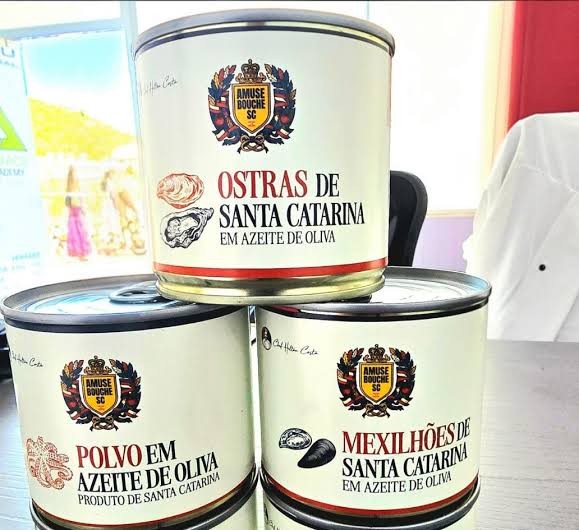
Yet it was a can that has just changed the commercial horizon of one of Santa Catarina’s most traditional production chains. Florianópolis has certified the first Brazilian plant authorised to produce canned oysters and mussels, and the consequences go well beyond the supermarket shelf.
The bottleneck was never production
Mariculture in Santa Catarina knows how to farm. What it never solved was time.
Oysters and mussels are sold alive. The product leaves the water and starts racing the clock. It needs a cold chain, fast transport, a nearby buyer and a consumer willing to handle a living animal inside a shell.
In practice, that confined production to a radius of a few hours’ drive and to a high and low season calendar. A farmer in Palhoça or Governador Celso Ramos can be excellent at growing and still depend on restaurants less than three hundred kilometres away.
Commercial sterilisation breaks precisely that lock. The mollusc stops being a live product and becomes a shelf-stable food, with long validity, that travels without refrigeration and crosses borders.
Process technology is technology too
The certification came from the Municipal Inspection Service of Florianópolis, with technical support from professor Giustino Tribuzzi of the Federal University of Santa Catarina. The approved company is Amuse Bouche SC, in the Saco Grande district.
It is worth insisting on one point: what is at stake here is food engineering. Defining the time and temperature binomial, validating heat penetration to the centre of the pack, ensuring the process removes microbiological risk without turning the oyster into rubber, and proving all of it before a sanitary authority.
In nature, that is no different from validating a composite material or an onboard control system. It is applied research solving a concrete industrial problem.
And it happened at the junction of three actors the sector usually keeps apart: a private company, a public university and a municipal inspection body.
The numbers that explain why it matters
To grasp the scale of what is at stake, look at the size of mariculture in Santa Catarina.
According to the IBGE Municipal Livestock Survey released in September 2025, Brazilian mollusc farming reached 9.56 thousand tonnes in 2024, up 21.7% on the previous year, with a production value of BRL 119 million.
Santa Catarina alone accounts for 91% of that total: 8.7 thousand tonnes of oysters, scallops and mussels, worth BRL 102 million.
Florianópolis leads national oyster production, at around BRL 37 million, and is also the country’s largest producer of mollusc seed, the input on which the whole chain depends. Palhoça, Bombinhas, Penha, Governador Celso Ramos, São José and São Francisco do Sul complete the group of leading producing municipalities.
Hundreds of farming families live from this activity along the coast. A sector with that productive density and almost no processing industry is a sector operating below its potential.
What canning does to added value
There is a large economic difference between selling raw material and selling a product.
A live oyster is a very short-term commodity, with prices squeezed in high season, when everyone harvests at once. A canned product is another category: it has a brand, a label, a story of origin, a shelf and a price detached from the day of harvest.
It also solves the surplus problem. The farmer stops being hostage to the production peak, because whatever is not sold fresh can be processed.
And it opens the export door. A food that is stable at room temperature can be shipped in a dry container to any market in the world, without the expensive and fragile logistics of a live product.
The missing piece in the chain
The nautical sector and the Ocean Economy have been discussing for years the need to add value to Brazilian production instead of exporting raw volume.
Mariculture is almost a textbook case. Brazil has one of the best coastlines in the world for mollusc farming, consolidated production technology, absolute leadership concentrated in a single state and, until now, almost no industry to turn that into a packaged product.
The Florianópolis certification sets a regulatory precedent. It shows the technical and documentary path for anyone wanting to do the same, and creates a reference for other municipalities and other seafood products.
It is worth remembering that Florianópolis is a UNESCO Creative City of Gastronomy, a recognition grounded precisely in its fishing tradition and mariculture. An industrialised product with an identity of origin is exactly the kind of asset that gives commercial substance to that title.
Innovation is also unlocking an entire chain
Blue Tech Radar follows technologies transforming the Ocean Economy. They do not always look like technology.
An autonomous drone is more impressive than an autoclave. But when an industrial process allows hundreds of producing families to reach markets that were previously out of reach, the economic effect can be greater than that of much sophisticated equipment.
Fishing and aquaculture are among the axes of Blue Nautical Hub Brasil for exactly this reason. Farming equipment, processing, packaging, cold chain, traceability and certification are part of the same ecosystem that discusses propulsion, electronics and new materials.
Mariculture in Santa Catarina has already proved it knows how to produce. Now it is starting to prove it also knows how to industrialise.
Blue Tech | Santa Catarina mariculture in numbers
Brazilian mollusc production in 2024: 9.56 thousand tonnes, up 21.7% on 2023, worth BRL 119 million. Santa Catarina share: 91%, with 8.7 thousand tonnes and BRL 102 million. Oyster leadership: Florianópolis, at around BRL 37 million, also first in seed production. Other leading municipalities: Palhoça, Bombinhas, Penha, Governador Celso Ramos, São José and São Francisco do Sul. Source: Municipal Livestock Survey, IBGE, released September 2025.
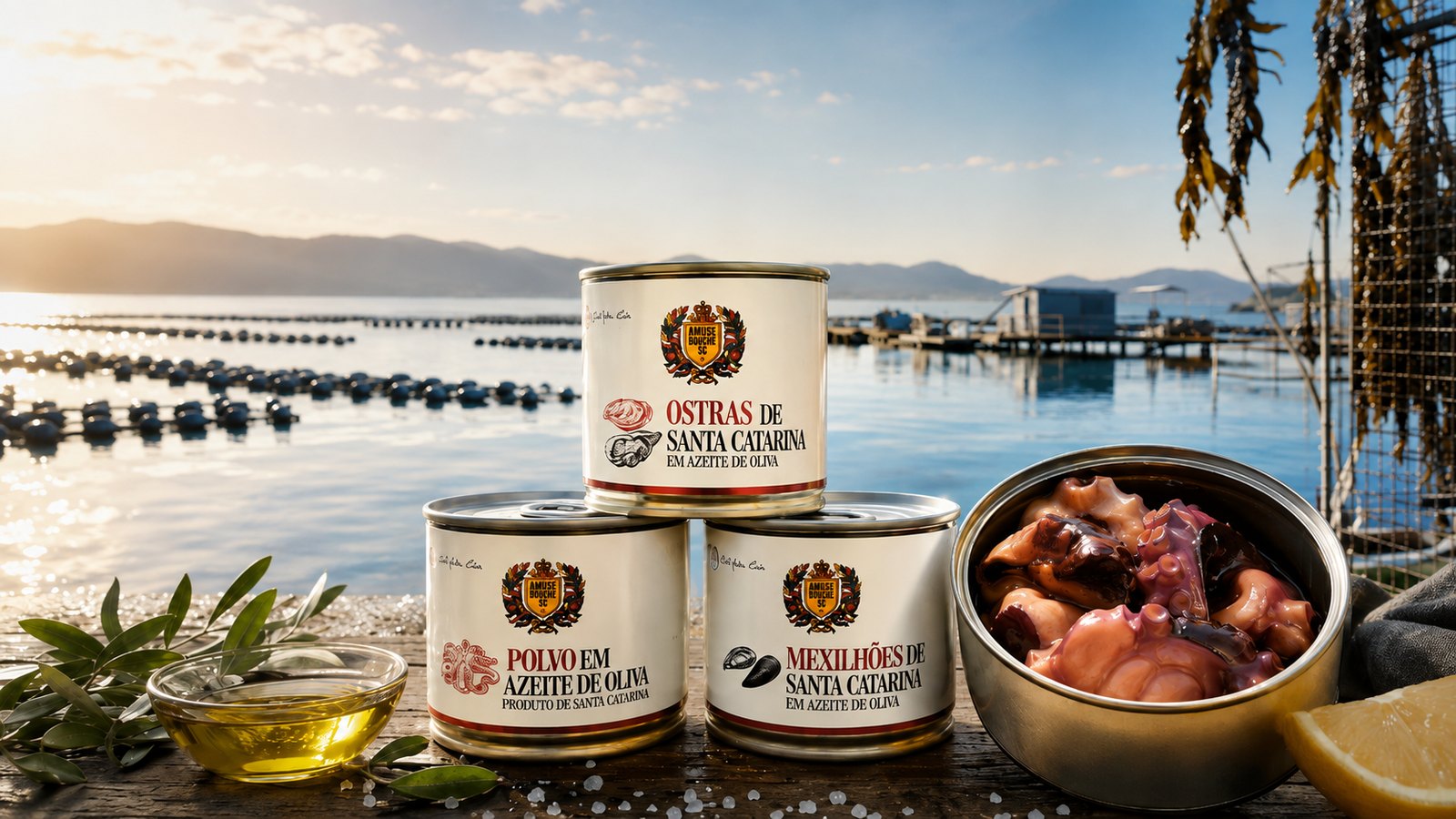
Blue Nautical Hub Brasil report, with information from the Florianópolis City Hall and data from IBGE and Epagri. The cans in the opening image are press material from Amuse Bouche SC and the Florianópolis City Hall. The background scene was composed with artificial intelligence.