
BLUE TECH RADARTechnologies that are transforming the sea.
AI has entered the shipyard: how artificial intelligence is changing the way boats are designed and built
From hull design to quality inspection, algorithms, digital twins, computer vision and robotics are starting to transform one of the world’s most traditional industries. The next generation of vessels may be born first in the digital environment and reach the water with fewer errors, more efficiency and far more data.
August 2026
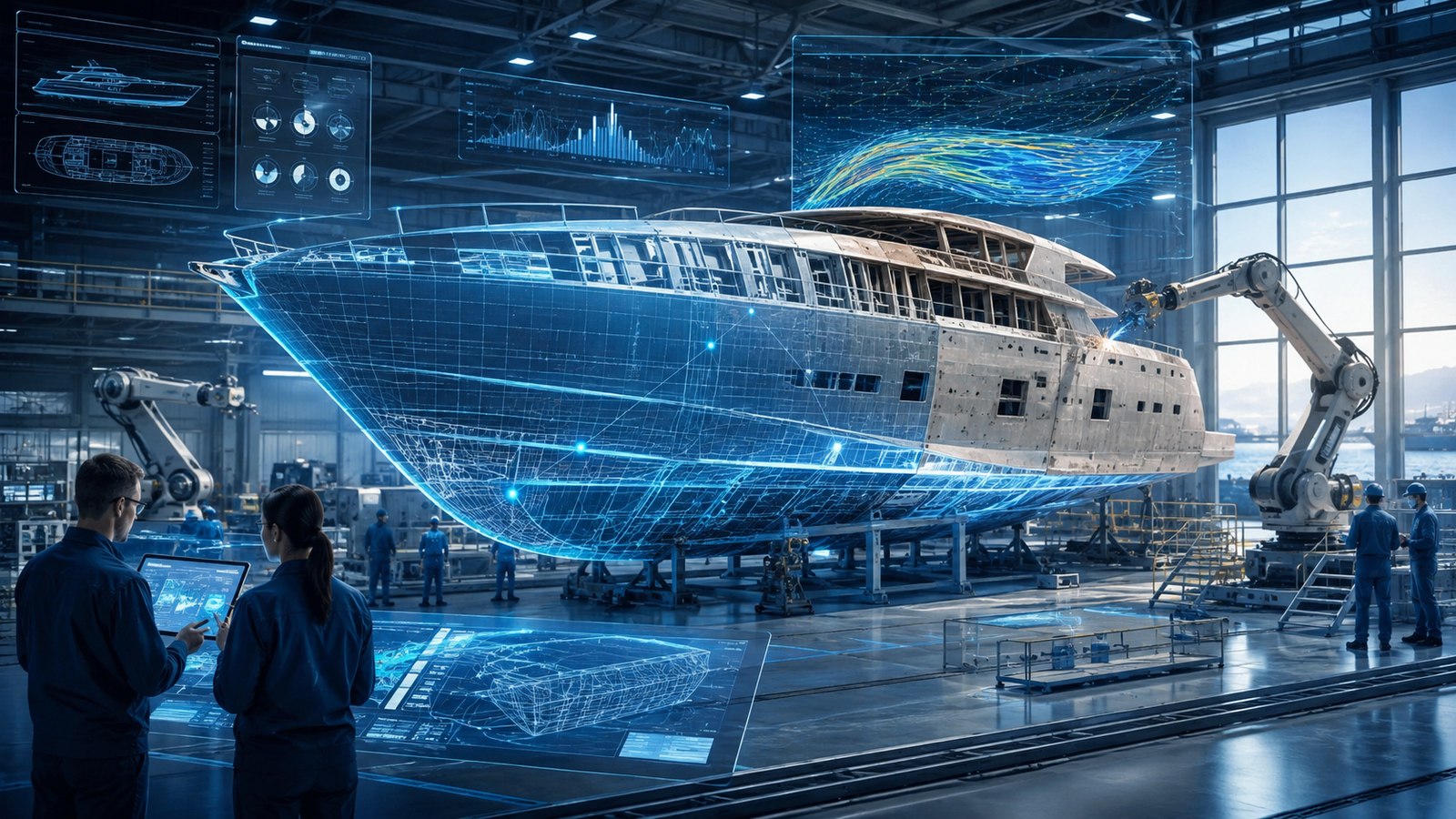
For decades, building a vessel meant combining accumulated experience, naval engineering, countless hours of drawing, calculations, simulations, prototypes and a sequence of decisions taken between designers, suppliers and the shop floor. That logic has not disappeared, but a new tool has started to enter the process: artificial intelligence.
And it arrives long before the electronic dashboard or the smart systems we find on board. AI starts taking part when the boat does not yet exist, in defining the project, in hull design, in hydrodynamic simulations, in structural calculation, in production planning, in quality inspection and even in creating a digital replica that can follow the vessel throughout its service life.
The shift matters because it changes a historical logic of shipbuilding. Instead of building and only then discovering how a given solution behaves, it will increasingly be possible to find out in the digital environment before building.
The boat can be born thousands of times before it exists once
The traditional development process involves many iterations. Changing length, beam, displacement, weight distribution, equipment position or hull geometry can have consequences for hydrodynamic resistance, stability, structure, consumption and behaviour at sea. That is why an apparently simple decision may require new calculations and new simulations.
Artificial intelligence speeds up that exploration. Instead of a designer working with only a few alternatives, generative design and machine-learning-based optimisation systems analyse a far larger number of combinations and help identify configurations that meet several objectives at once: lower resistance, lower weight, greater stability, more interior space, lower energy consumption and better performance, always within the constraints set by the engineers.
A study published in 2025 on applying artificial intelligence to yacht design describes exactly that change: generative AI, machine learning, CFD and digital models begin working in an integrated way to speed up the concept and evaluation stages. In June 2026, research published in the scientific journal Ocean Engineering went further, presenting a methodology that combines generative AI and evolutionary optimisation to develop hull forms driven directly by performance.
It is a fundamental change. Artificial intelligence stops serving only to produce a pretty picture of a futuristic boat and starts helping to find the geometry that makes the boat work better.
AI and CFD: speeding up the heaviest stage of naval engineering
To grasp the scale of this transformation you have to talk about CFD, computational fluid dynamics. These simulations make it possible to predict how water and air will interact with the hull, studying resistance, wave formation, pressure, flow and a range of phenomena that are fundamental to performance.
The problem is that a high-accuracy CFD simulation demands major computing power and time. That is where artificial intelligence models come in. Once trained on previous results, they work as surrogate models, able to quickly estimate the behaviour of given configurations.
Engineering still uses CFD to validate, but it no longer needs to run a full simulation for every small change made during early exploration. In practice, that allows many more possibilities to be tested within the same development window.
The question is no longer only whether that hull works. It becomes another one: among thousands of possible alternatives, which have the best chance of delivering the result being sought.
The digital twin begins before the boat
Another core technology in this transformation is the digital twin. It is not simply a 3D model. A true digital twin brings together geometry, equipment, systems, engineering data and, in more advanced applications, information coming from the vessel itself. The aim is to create a virtual representation able to follow the product throughout its life cycle.
In shipbuilding, that means the boat can exist digitally before production starts. Piping can be checked, cable runs analysed, equipment repositioned, interference between systems discovered, assembly sequences simulated and maintenance access assessed. Problems that used to appear only when the installer reached the boat start being found on screen.
Large groups already treat that integration as a core part of their industrial strategy. Italy’s Fincantieri works with artificial intelligence, the internet of things and digital twins within the transformation of its design and production processes, with digital models of product and process that make it possible to follow construction, simulate situations and optimise decisions. Spain’s Navantia follows a similar direction with its Shipyard 5.0 concept, integrating robotisation, artificial intelligence and digital twins into naval production.
These are technologies developed in large naval projects, but they point to a trend with the potential to reach different scales of the industry, including leisure boat yards.
3D design is also changing naval classification
The transformation is even reaching the way projects are assessed. In August 2026, Lloyd’s Register presented what it describes as the maritime sector’s first dedicated guidance for using digital 3D models in the class approval process. The document, identified as LR-GN-066, sets out file formats, model organisation, metadata requirements, levels of structural detail, revision control and submission rules, allowing intelligent 3D models to be used in place of traditional two-dimensional plans in the early stages of structural approval.
It is an apparently bureaucratic and deeply technological change. Historically, much of structural approval depends on extensive sets of two-dimensional technical drawings. When the digital model stops being merely a visual representation and takes part in the formal engineering process, the whole chain can work from the same base of information: design, production, supplier, class society, maintenance and operation.
The boat begins to carry a kind of digital identity from construction onwards.
On the shop floor, AI starts to gain eyes
If in the engineering office artificial intelligence works with models and simulations, inside the yard it gains sensors, cameras and robots. One of the most promising applications is computer vision, in which cameras combined with algorithms analyse images and identify patterns that are hard for the human eye to track continuously.
In the naval industry there is already research and application aimed at weld inspection, tracking construction progress and verifying components. A 2025 study on intelligent robotics in shipbuilding describes drones able to move through production areas recording images of weld beads, which are then analysed by algorithms looking for possible defects. Another path uses laser scanning to compare what has actually been built with the planned digital model.
The principle is powerful: the yard starts automatically comparing the real boat with the digital boat. When there is a difference, the system can flag it before that small divergence becomes rework in the following stages.
Robots that stop repeating and start perceiving
Industrial robotics is nothing new. What changes with artificial intelligence is the capacity to adapt. A conventional robot repeatedly executes programmed movements. More advanced systems combine cameras, sensors and artificial intelligence to recognise variations in the environment and adapt the task.
In shipbuilding, current research explores welding, grinding, inspection, material handling, internal logistics, dimensional survey and production monitoring. That is particularly relevant because building a boat is different from manufacturing millions of identical parts. There is variation, there are complex spaces, there are components installed at different stages and there is customisation. Artificial intelligence can help robotics work in precisely that less predictable environment.
AI also changes the shipyard’s shopping list
There is also a less visible transformation, perhaps as economically important as hull design. A modern vessel brings together thousands of components, from engines, pumps, piping, valves, cables and connectors to electronics, wood, composites, hardware, air conditioning systems and safety equipment. Managing that chain means controlling availability, lead time, stock, specification and cost.
Fincantieri already places artificial intelligence among the tools aimed at optimising engineering and procurement. That reveals an important dimension of the technology: AI in shipbuilding does not only mean designing better boats, it can mean building them more intelligently, anticipating material shortages, improving planning, organising logistics, cross-referencing engineering with component availability, identifying delay risk and reducing one of the most expensive problems in any industry, which is rework.
Building with a boat that will keep learning in mind
There is also a conceptual change. Traditionally, the yard delivers the vessel and much of the data produced during development is left behind. In the new model, the boat can leave the yard carrying its digital identity with it.
Sensors installed on board feed data on engines, batteries, air conditioning, consumption, vibration, temperature and countless other systems. That data can return to the digital twin, and AI starts comparing predicted behaviour with real behaviour. Is a pump drawing more energy than it should? Has the vibration of a given piece of equipment started to change? Is the temperature showing an abnormal pattern? The system can identify trends before a fault becomes a breakdown.
This brings construction and operation closer together and creates extremely valuable information for the builder. A yard accumulating data, respecting security and privacy rules, on hundreds of vessels in operation can discover which solutions worked best in the real world and use that knowledge in the next generation. In that scenario, every boat delivered helps design the next one.
Less weight also means less energy
Artificial intelligence arrives at a moment of major energy transformation in the sector, with electric propulsion, hybrid systems, batteries, hydrogen, new materials and pressure to cut emissions. All of these technologies raise the importance of optimisation. On an electric boat, weight means energy, hydrodynamic resistance means energy and mass distribution means performance. Combining structural, hydrodynamic and energy optimisation makes it possible to attack several of those problems at once.
Digital twins are also starting to be used in developing and testing electric propulsion systems. In January 2025, class society DNV signed a memorandum with HD Hyundai Mipo and HD Korea Shipbuilding & Offshore Engineering to develop criteria and procedures for testing electric vessels based on digital twins, using hardware-in-the-loop trials to bring systems integration testing forward. Virtualisation therefore also becomes part of the energy transition.
But AI does not replace the naval engineer
This may be the most important distinction. Artificial intelligence can generate alternatives, identify patterns, cross-reference large volumes of data, speed up calculations and suggest solutions. But a vessel is a physical system operating in an extremely complex environment, involving stability, structure, fatigue, fire, electricity, behaviour at sea, passenger safety, standards, classification and technical responsibility.
That is why there is no room to simply accept an answer produced by an algorithm and build the boat. DNV itself develops specific practices for what it calls assurance of AI-enabled systems, precisely because algorithms need to be tested, monitored and validated throughout their life cycle. Lloyd’s Register has also been advancing in the formal assessment of maritime AI and digital twin applications.
The trend does not point to the disappearance of the designer. It points to a professional with far more powerful tools. AI does not replace engineering, it expands engineering’s capacity to explore, compare and decide.
What changes for the Brazilian nautical industry
For Brazil, and especially for boatbuilding hubs such as Santa Catarina, this transformation opens a concrete opportunity. Not every innovation will have to be born inside a large shipyard. The new shipbuilding creates room for companies specialising in software, sensors, artificial intelligence, simulation, 3D modelling, automation, computer vision, marine electronics, robotics, digital twins, new materials and data engineering.
It is an important change in the supply chain itself. In the past, when people thought of a shipyard supplier, the image was of engines, hardware, wood, fibre, resin and equipment. Now there is a new layer: the supplier of the next boat may also sell code, algorithms and data.
The boat of the future starts in the computer and ends in the real world
Artificial intelligence will probably not produce the next great boat on its own, and that may not even be the right question. The transformation that matters happens when engineers, designers, suppliers and builders start using AI to make thousands of small better decisions along the way: choosing a geometry, saving a few kilos, finding an interference, avoiding rework, detecting a poor weld, predicting a failure, optimising an installation, planning a purchase, testing a system virtually.
Added up, those small gains can profoundly change the way a vessel is built. The yard will still smell of resin, aluminium, steel and wood. But increasingly there will be an invisible raw material mixed into all of it: data. And that may be exactly where the next great revolution in boatbuilding is beginning.
Blue Nautical Hub Brasil report, with information from Lloyd’s Register, DNV, Fincantieri, Navantia and scientific publications from the sector. The opening image is an illustration generated by artificial intelligence.