BLUE TECH RADARTechnologies that are transforming the sea.
3D printing in boating: from prototyping toy to a part that goes on board
The nautical industry is almost the perfect case for additive manufacturing: small series, heavy customisation and parts nobody produces in the millions. Italy’s Superfici was among the first to take that seriously.
August 2026
For a long time, industry treated 3D printing as a mock-up tool. It served to see the part before ordering the real part.
That phase is over. There are printed components running on board today, in a saline environment, under structural load and sun exposure. And the nautical sector is among those with the most to gain, for a reason almost nobody states clearly.
Why boating is the perfect case
Classic industrial logic is simple: the larger the series, the cheaper the part. An injection mould is expensive, but it spreads over a hundred thousand units.
Boating does not work that way. A shipyard produces dozens or a few hundred units of a model, often with a different layout on each boat, because the client asks for it. It is the worst possible scenario for moulds and the best possible scenario for additive manufacturing.
Add the nature of the product. A boat has hundreds of small, specific parts: brackets, ducts, covers, consoles, caps, trim, instrument bases. None of them justifies dedicated tooling, and all of them are expensive precisely for that reason.
Then there is weight. On a vessel, every kilo saved is performance or range. 3D printing allows hollow geometries and internal structures that machining and injection simply cannot produce.
The console that proved the point
The clearest demonstration of this appeared at Seatec, the Italian nautical technology fair held in Carrara.
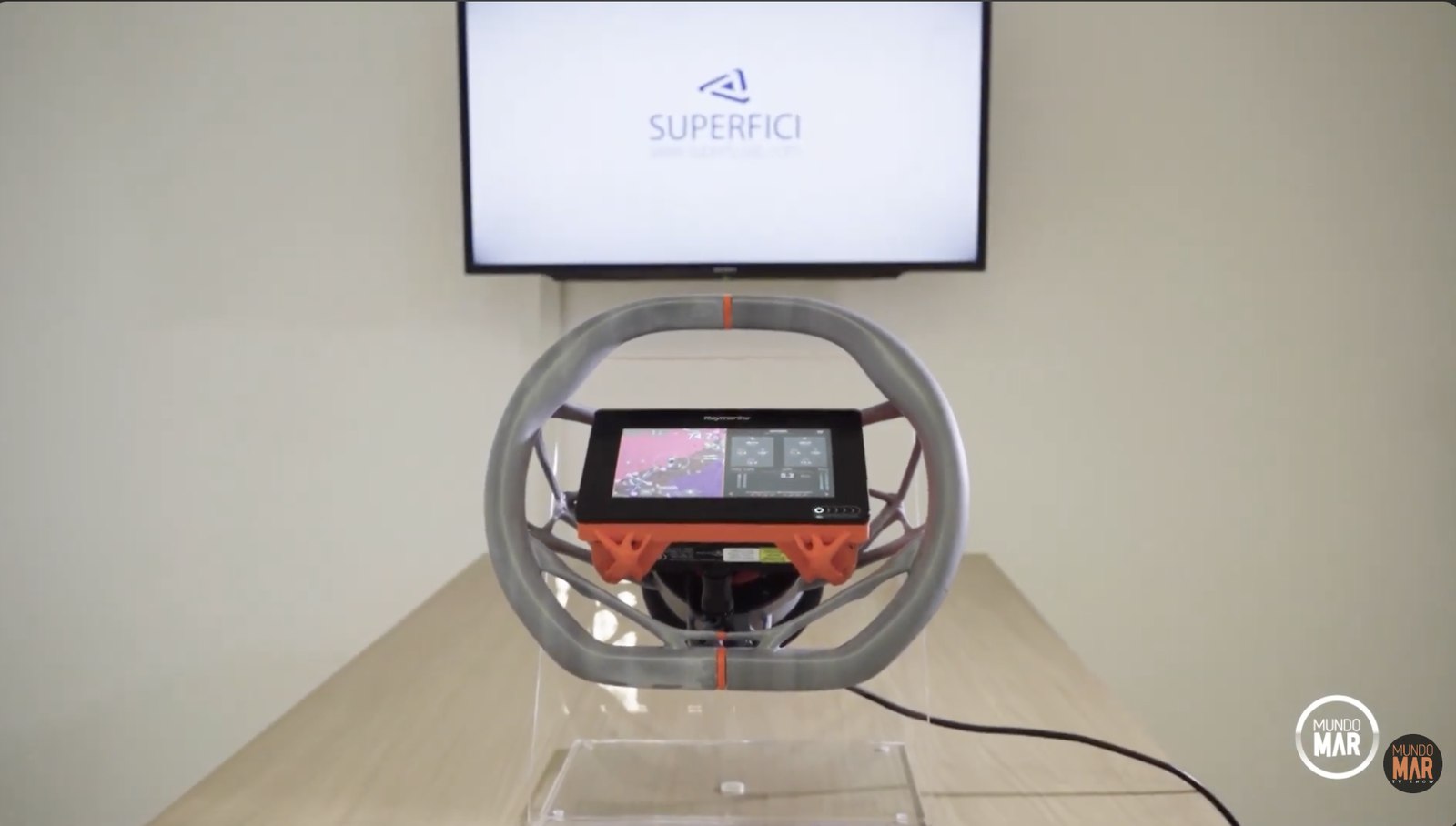
Superfici, a company founded in 2016 in Liguria and based in La Spezia, presented in 2019 a complete 3D-printed helm console, developed in partnership with the Sacs Marine shipyard for the Sacs Strider 700.
It was not a demonstration trinket. The console measured 97 centimetres long, 70 high and 90 deep, weighing around 25 kilos, with a 12-inch Raymarine Axiom display and a Hertz Marine audio system already integrated into the structure.
The technology used was FDM, fused deposition modelling, with a high-speed printing plastic. The company presents itself as one of the few in the world able to print an entire boat console.
The work earned three recognitions that year: the Innovative Design Technology Award 2019 from ADI Toscana, victory in the Startup Arena elevator pitch competition, and a special mention in the Qualitec Technology Award.
Integrating instead of assembling
The most interesting detail of the console is not that it was printed. It is that it was printed whole.
A conventional dashboard is an assembly: structure, cladding, cut-outs, instrument brackets, cable runs, fixings. Each item has a supplier, a lead time, a tolerance and an assembly step.
When the part comes off the printer with all of that built into its own geometry, an entire sub-assembly chain disappears. Fewer screws, fewer points where water gets in, fewer labour hours, less risk of error on the line.
That is the leap separating prototype 3D printing from production 3D printing.
The part that no longer exists
There is a second application, less glamorous and perhaps more valuable day to day: spare parts.
A boat lasts decades. A component supplier does not always. Anyone looking after a twenty-year-old vessel knows the situation well: you need a part nobody makes any more, for a discontinued model, from a company that may no longer exist.
That is exactly where 3D scanning and reverse engineering come in, two services Superfici offers alongside printing. The broken part is digitised, the geometry is corrected and one unit is printed. Just one.
For a marina, a repair yard or a charter fleet, that is vessel availability. A boat sitting idle waiting for a part is a direct loss.
What this changes for the Brazilian shipyard
Brazil has a nautical industry operating in exactly the conditions where additive manufacturing pays off most: short series, a high degree of customisation and dependence on imported components.
That last point deserves attention. Much of the cost and lead time of a Brazilian project comes from parts arriving from abroad, with exchange rate, freight and waiting time built in. A share of those parts is technically printable right here.
This is not a replacement for everything. Hull, engine and structural systems stay where they are. But the universe of brackets, trim, bases, ducts and interior components is large, and it is exactly where 3D printing is already mature.
Superfici, incidentally, does not only sell parts. It also sells printers, support and digital manufacturing training. It is a business model that makes sense for anyone wanting to bring the technology inside their own yard rather than outsourcing every component.
A technology that matured quietly
Blue Tech Radar follows technologies transforming the Ocean Economy. 3D printing is a curious case because it has already been through the full hype cycle.
It was an absolute novelty, became an exaggerated promise, disappointed those expecting to manufacture anything at home, and then vanished from the headlines. While it was vanishing from the headlines, it got good.
Materials improved, printing speed increased, topology optimisation software became affordable and the cost per part fell. The discussion today is no longer whether you can print. It is which parts are worth printing.
Companies like Superfici are useful precisely because they lived through that whole period. They started when the technology was still viewed with suspicion in the nautical sector and got here with parts running on board.
That is the kind of track record Blue Nautical Hub Brasil wants to bring inside the fair: technology that has already left the laboratory and is ready to talk to the people who build boats.
Blue Tech | Superfici in numbers
Company: Superfici S.c.r.l., founded in 2016 in Liguria, based in La Spezia, Italy. Technology: FDM, fused deposition modelling, with Italian-made materials. Services: on-board components, scale models, prototypes, 3D scanning, reverse engineering, printer resale and support, and digital manufacturing training. Console presented at Seatec 2019 with Sacs Marine for the Sacs Strider 700: 97 cm long, 70 cm high, 90 cm deep, around 25 kg, with an integrated 12-inch Raymarine Axiom display and Hertz Marine audio. Recognitions in 2019: Innovative Design Technology Award from ADI Toscana, Startup Arena elevator pitch competition and a special mention in the Qualitec Technology Award.
Blue Nautical Hub Brasil report, with information from Superfici and from the coverage of the Mundo Mar programme, which interviewed the company on two occasions.