BLUE TECH RADARTechnologies that are transforming the sea.
Marine electronics has become the nautical industry’s main battleground
Bluetooth engine cut-off, artificial intelligence reading the ocean, 4K displays, VHF controlled from a smartwatch and propellers that burn less fuel. The 2026 releases show a sector where value has moved from the hull to the software.
August 2026
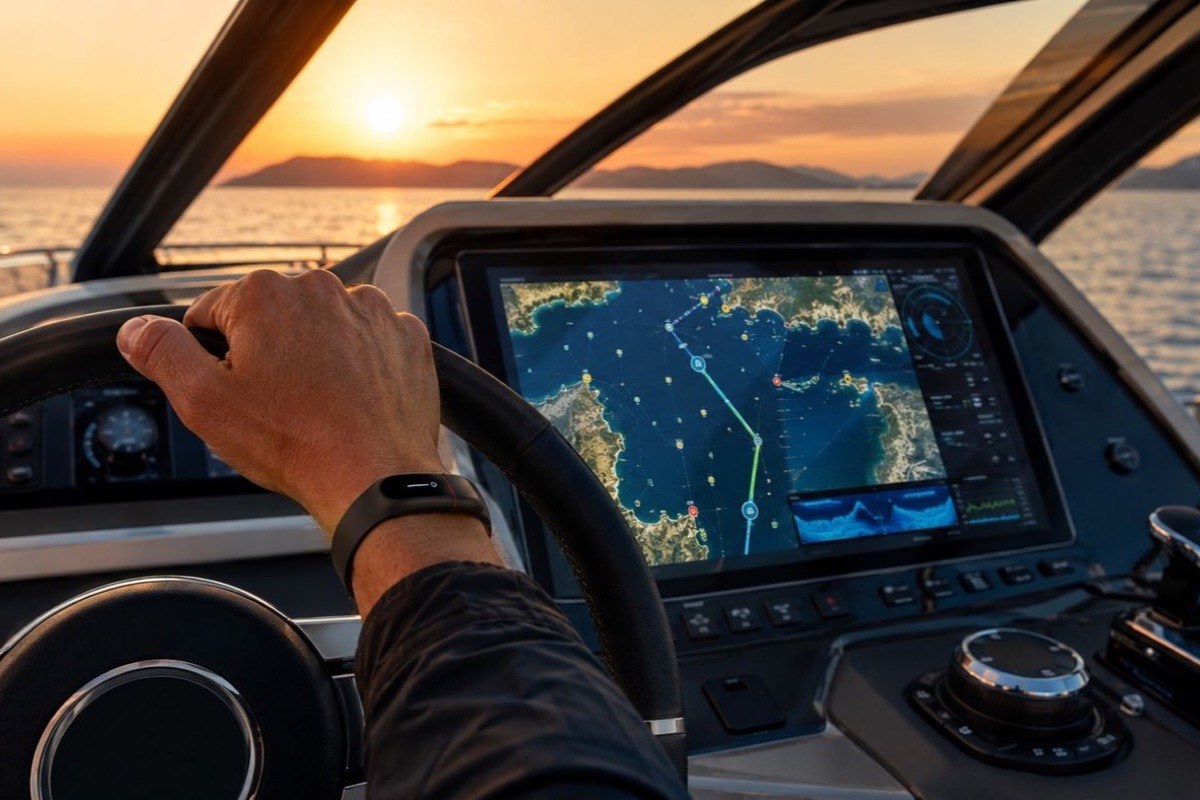
For decades, the conversation about nautical innovation revolved around the hull: waterline, materials, bottom design. In 2026, the contest moved address. It is now in the dashboard, the sensors and the software.
The releases presented by international manufacturers this year organise themselves around three words: safety, efficiency and connectivity. And almost all of them depend on suppliers who do not build boats.
Safety that does not depend on a lanyard
The simplest item on the list may be the most significant. Bluetooth engine cut-off replaces the old safety lanyard clipped to the driver’s wrist with a wristband connected to the boat.
If the operator falls overboard or moves too far from the helm, the engine shuts down on its own. That removes the runaway-boat scenario, circling over the person who fell, one of the gravest causes of accidents in recreational boating.
It is a small piece of electronics solving a problem decades of training did not solve.
Artificial intelligence applied to the ocean
Artificial intelligence has left the realm of promise and become a menu function. Navigation systems now cross real-time data to plan routes and forecast conditions with a precision that once required specialist consultancy.
Fishing-oriented applications already combine decades of oceanographic data with scientific modelling and show, on the helm display itself, surface temperature, currents and the areas of highest probability.
For the sector, the relevant fact is not the novelty itself. It is that value has moved to the model and the database, not the device that displays them.
The helm station became a network
The new generation of multifunction displays works with 4K resolution and high-speed internal networks that integrate sonar, charts, radar and cameras into a single environment.
Connectivity followed the same path. VHF radios can now be operated from a phone or a watch, with integrated AIS, the technology that lets vessels see each other and avoid collision.
The boat no longer has isolated equipment; it has a network architecture. Whoever supplies that architecture holds a strategic position in the chain.
Efficiency that shows up on the bill
On the propulsion side, propellers with new geometry promise more economical, smoother and quieter navigation. On board, new-generation refrigeration units arrive consuming around 15% less energy and using lower-impact refrigerant gases.
These are gains that matter to the operator before they matter to the environmental argument: less fuel and less electrical load mean greater range and lower operating cost.
What this changes in the supply chain
Add it all up and the picture is clear. A modern boat is a platform integrating electronics, software, sensors, connectivity, batteries and positioning systems.
Much of today’s added value is delivered by companies that have never laminated a hull: software developers, sensor manufacturers, network integrators, telecommunications and energy companies.
It is this chain that Blue Nautical Hub Brasil places at the centre of its 2027 edition.
Where these technologies will meet in 2027
The edition runs from 26 to 30 April 2027, in Santa Catarina, Brazil, and brings a B2B professional trade fair dedicated to technology, products, components and services for the Ocean Economy.
It is not a boat show. The aim is to bring together those who develop and supply technology with those who buy, specify and integrate these solutions: shipyards, marinas, distributors, port operators, fishing, defence and service companies.
The ten planned areas include electronics, technology and software; engines, propulsion and energy; maritime defence and security; and sustainability and Blue Economy, plus the Startup Arena and the Green-Blue Innovation Hub.
Brazil has coastline, a growing fleet and a market still underserved by some of these technologies. Bringing supplier and buyer together is exactly the work the Hub sets out to do.
Brazilian and international companies interested in presenting products and solutions at the 2027 edition can already pre-register their interest through the official website.
Blue Nautical Hub Brasil feature, with information from sector manufacturers. Illustration: AI, Mundo Mar.