
BLUE TECH RADARTechnologies that are transforming the sea.
Sustainable composites: boating’s answer to the boat that never ends
The fibreglass that made the industry grow has created a liability of two million tonnes of hulls with nowhere to go in Europe. Recycled materials, natural fibres and composites designed to be taken apart attack the problem at its source.
August 2026
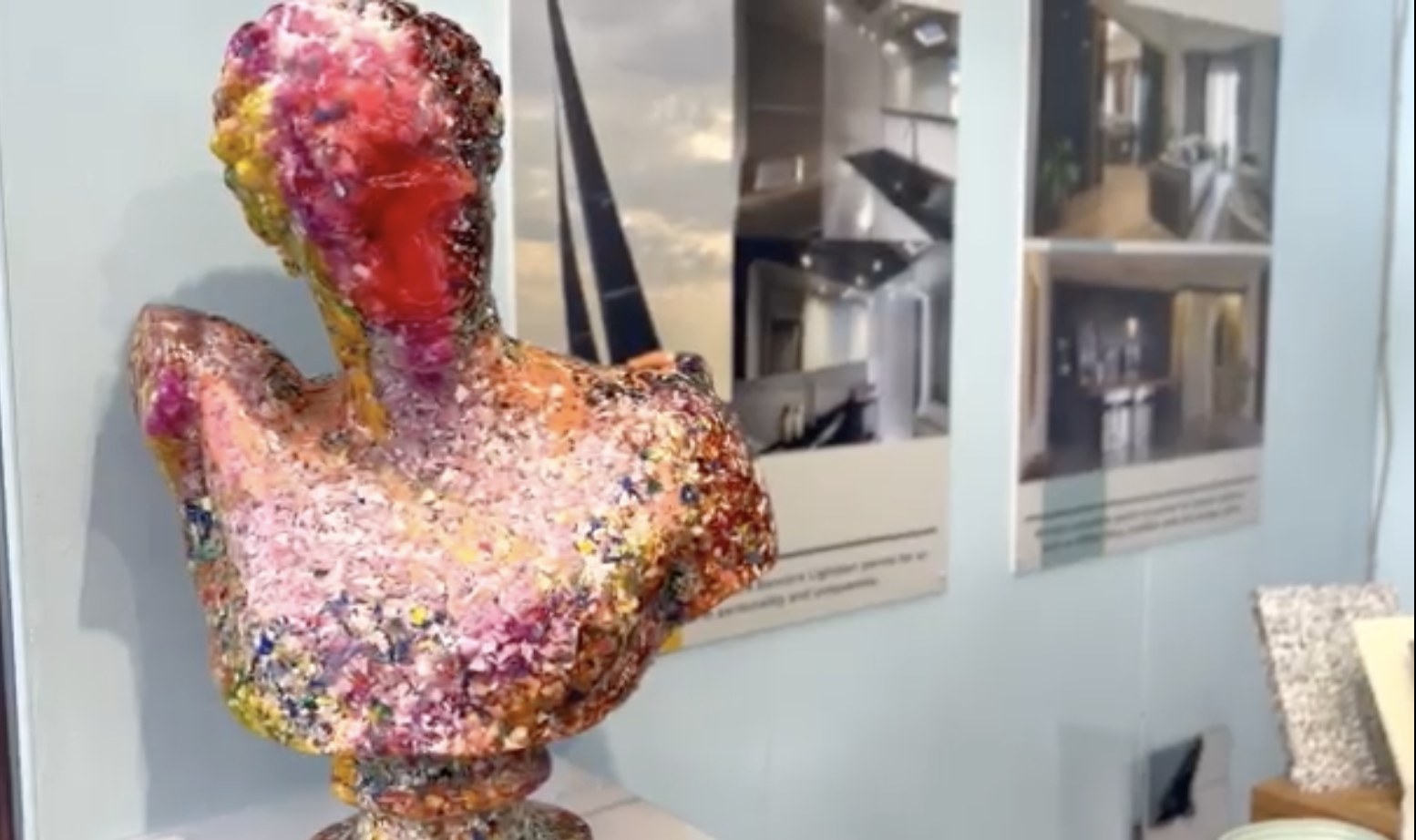
At a European composites technology trade fair, a colourful bust drew attention on top of a white pedestal. From a distance it looked like stained marble. Up close, it was something else: thousands of fragments of recycled plastic pressed into a single piece.
Beside it, a panel explained that the interiors of a Wally Tango sailing yacht used Bencore Lightben panels. The sculpture was not decoration. It was the entire sales argument summed up in one object.
The problem the sector avoids looking at
The modern nautical industry was built on fibreglass. It is cheap, mouldable, strong and practically eternal. That last adjective is the problem.
A fibreglass hull does not decompose and does not easily return to being raw material. When a boat reaches the end of its life, two traditional exits remain: landfill or incineration.
The European figures show the scale. There are around two million tonnes of hulls awaiting a disposal solution. Projections put more than thirty thousand boats a year reaching end of life in the European Union, representing some 23 thousand tonnes of composite waste annually. In the British marine sector alone, around 55 thousand tonnes of fibre waste are produced each year, with estimated growth of 10% a year.
European Boating Industry has committed to phasing out landfill and energy recovery by 2030, expanding recycling solutions in coordination with other composite-using sectors, such as wind energy.
One figure explains why that coordination is indispensable: recreational and commercial boating accounts for only 2% to 3% of all composite consumed in Europe. On its own, the sector has no scale to make a recycling industry viable. It needs to ride along with the wind turbine blade, which faces exactly the same deadlock.
Sustainable composite is not one material
When people talk about sustainable composites, they usually imagine a single magical invention. That is not the case. There are three different paths, solving different problems.
The first is recycled content: using as raw material something that was already something else. Post-consumer plastic, cardboard, industrial waste.
The second is natural fibre. Flax, basalt and other fibres replace part of the glass, cutting production impact and, in some cases, improving vibration damping.
The third is the most structural and the least discussed: designing for disassembly. Thermoplastic composites can in theory be reheated and reprocessed, unlike thermoset resin, which cures once and never goes back.
From industrial panel to yacht interior
Bencore is a good picture of how that transition happens in practice. The Italian company is based in Carrara, with production in Massa, and has been making honeycomb composite panels for more than twenty years. It started with industrial applications, among them truck beds and boat building.
Lightben, used on the Wally Tango, is an ultralight panel whose core is formed by transparent polycarbonate cylinders, with outer skins in polycarbonate, PETG or acrylic. Seen head-on it looks translucent; seen at an angle it closes and provides privacy. It is light because it is mostly air.
Ecoben takes the logic further: a core of recycled cardboard and skins of 100% recycled and recyclable acrylic, in thicknesses between 21 and 34 millimetres. The material carries certifications for fire reaction, acoustic absorption and soundproofing, which is what allows it to be specified in a real project.
Why the interior is the best place to start
There is a practical reason why sustainable material enters a vessel through the interior before reaching the hull.
A hull is structure, and structure is regulated, certified and conservative by nature. Nobody changes the laminate recipe because of an environmental argument without years of testing.
Partitions, doors, panels, furniture and trim, on the other hand, carry far lower risk, are highly visible to the client and are replaceable over the life of the boat. It is the shortest path between an intention to be sustainable and a part actually installed.
And there is weight. A honeycomb panel weighs a fraction of an equivalent solid panel. On a vessel, weight saved in the interior becomes lower consumption, greater range or extra payload.
The innovation that goes beyond the material
There is a point in this story more important than the panel itself, and it goes unnoticed.
Lightben panels carry an EPD, the Environmental Product Declaration, obtained through the Life Cycle Assessment method. It is a document that measures the product’s environmental impact from cradle to grave and publishes the result.
That changes the nature of the conversation. Without an EPD, sustainability is a catalogue adjective and everyone calls themselves green. With an EPD it becomes a number comparable between suppliers, and the designer can specify with criteria instead of believing a promise.
It is the same thing that happened with energy efficiency in home appliances. While there was no label, nobody compared. After the label, it became a purchasing criterion and the whole market moved.
The innovation that goes beyond, here, is not only the recycled material. It is the decision to measure and publish.
What this means for Brazil
The Brazilian nautical industry builds almost entirely in fibreglass and has, today, no structured composite recycling chain. The liability Europe is already counting, Brazil is still building up.
There is an advantage in that, if the sector chooses to use it. Whoever starts later can design for disassembly from the outset, instead of discovering the problem thirty years down the line with thousands of stranded hulls.
And there is a concrete commercial opportunity. Markets beginning to require environmental declarations will prefer the supplier that has one. For a Brazilian yard intending to export, that stops being talk and becomes a contract requirement.
New materials are among the axes of Blue Nautical Hub Brasil for exactly this reason. Resin, fibre, core, adhesive, finish and lamination process form an entire chain being rethought at the same time, and whoever supplies that chain needs to be in the same room as whoever builds boats.
A sculpture as an argument
Back to the colourful bust from the beginning. It is not there by accident, and it is not art by accident.
A sample of recycled panel is a grey rectangle nobody looks at twice. A sculpture made of the same material forces passers-by to come closer, touch it and ask what it is made of. The answer is the message.
It is a lesson worth remembering for any company taking technology to a trade fair: sustainable material is not sold with a speech, it is sold by letting people touch it.
Blue Tech | Sustainable composites in numbers
European liability: around 2 million tonnes of hulls awaiting a disposal solution. Annual flow: more than 30 thousand boats reaching end of life in the European Union, some 23 thousand tonnes of composite waste per year. United Kingdom: approximately 55 thousand tonnes of fibre waste per year in the marine sector, with estimated growth of 10% a year. Boating share of European composite consumption: 2% to 3%. European Boating Industry target: end of landfill and energy recovery by 2030. Bencore: head office in Carrara and production in Massa, Italy, with more than 20 years of honeycomb composite panels. Lightben: core of polycarbonate cylinders, skins in polycarbonate, PETG or acrylic, with an EPD based on Life Cycle Assessment. Ecoben: core of recycled cardboard and skins of 100% recycled and recyclable acrylic, thicknesses from 21 to 34 mm, with certifications for fire reaction, acoustic absorption and soundproofing.
Blue Nautical Hub Brasil report, with information from Bencore, European Boating Industry and composite sector publications. Photo: Mundo Mar.