
BLUE TECH RADARTechnologies that are transforming the sea.
AIS MOB turns personal location into a new safety layer for those who work and sail at sea
Distributed in Brazil by Navitec, the KS-33R combines GPS and AIS technology to transmit the position of a person in a man-overboard situation. The solution is already part of a fishing safety initiative in Santa Catarina and shows how electronics can reduce one of the greatest challenges of a maritime emergency: quickly locating whoever needs help.
August 2026
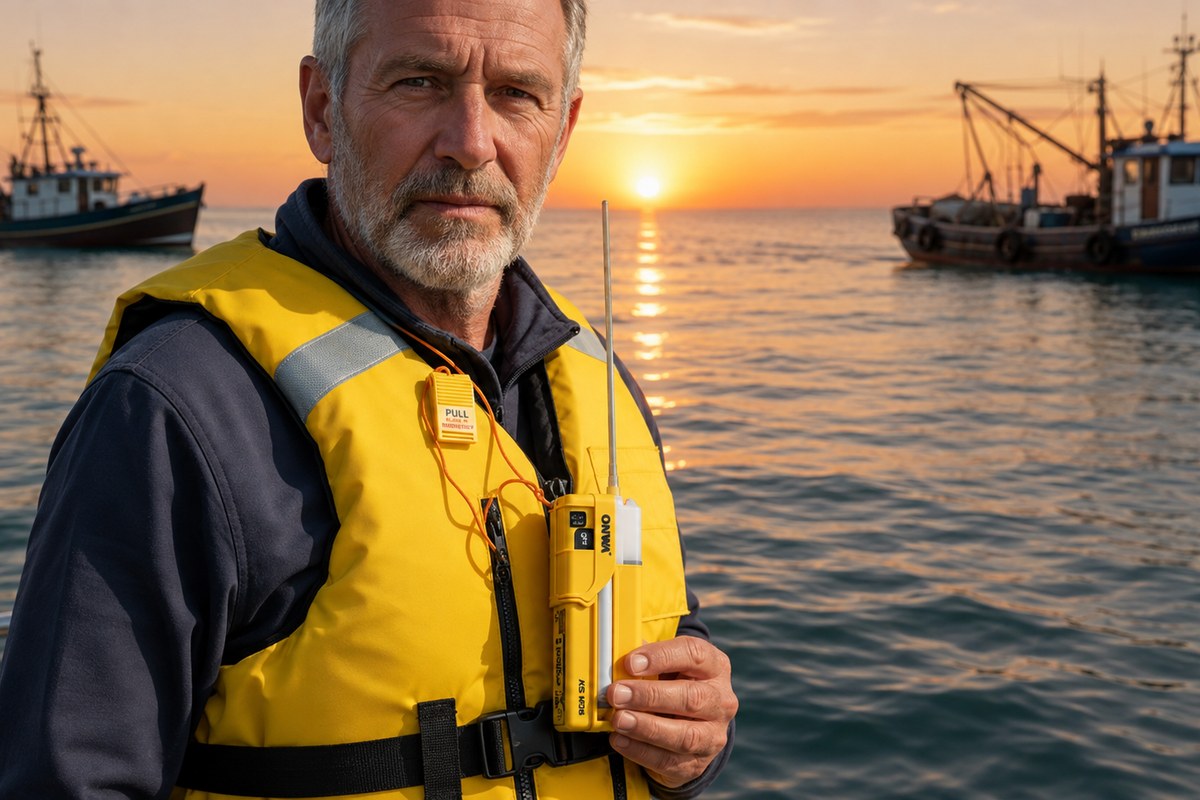
At sea, knowing that there is an emergency is not enough. You need to know where it is happening.
In a man-overboard incident, especially when the vessel is under way, quickly finding the person in the water can completely transform a search operation.
It is precisely to tackle this problem that AIS MOB devices exist, short for Automatic Identification System Man Overboard.
The KS-33R, manufactured by ONWA Marine and distributed in Brazil by Navitec, from Santa Catarina, is one of these technologies. It is a small personal locator designed to stay with the crew member and, when activated in an emergency, to transmit its identification and position to AIS equipment within range of the signal.
It is an application of marine electronics that places technology literally next to every person on board.
What happens when the device is activated
The concept is relatively simple, but technologically important.
The KS-33R has an internal GPS. When an emergency occurs and the device is activated, it determines the user’s position and starts transmitting messages on the international frequencies used by AIS. AIS equipment installed on nearby vessels can then receive the alert and see the device’s position.
According to the manufacturer, the KS-33R transmits on 161.975 MHz and 162.025 MHz, with a nominal power of 2 W. The GPS position is updated during operation and the device has an individual identification programmed at the factory.
In practice, the system turns a person in the water into an identifiable electronic point within the AIS ecosystem. And that significantly changes the logic of the search: instead of looking for someone across a large area of sea, the vessels receiving the signal now have a position to direct the operation towards.
AIS no longer identifies only vessels
The Automatic Identification System became known mainly as a technology for identifying and tracking vessels. But its infrastructure has also gained applications related to search and rescue.
International maritime authorities recognise AIS equipment intended for locating people in man-overboard situations. The Australian Maritime Safety Authority, for example, explains that devices of this type use specific identifications and allow AIS receivers within range to display the position of the emergency.
This creates a very interesting characteristic: the network of equipment already installed on nearby vessels can itself contribute to locating the person.
The logic is especially relevant in areas with maritime traffic, professional fishing, port operations, support vessels, nautical tourism and activities where several units operate relatively close to each other.
Small in size, specific in mission
The device measures approximately 130 x 50 x 24 millimetres and weighs around 120 grams, according to ONWA specifications. The manufacturer indicates a minimum endurance of 24 hours of continuous transmission after activation and a battery storage life of up to seven years.
ONWA also indicates a typical range of approximately 4 nautical miles, considering an AIS receiving antenna installed more than five metres above sea level. As with VHF communications, the real range depends on installation conditions, environment and reception.
The Brazilian product page lists applications ranging from artisanal fishing to maritime transport, nautical tourism, port services, marinas and leisure vessels.
Navitec recommends one individual unit per person on board plus one spare, a commercial and operational recommendation from the company rather than a general carriage requirement.
An important difference: AIS MOB is proximity location
There is a technical distinction here that deserves to be understood.
An AIS MOB such as the KS-33R works with the AIS network on VHF. Therefore, its ability to be detected by a vessel or by a shore station depends on the existence of receivers within range of the signal.
We are not talking about a device that, on its own, transmits the alert through a global satellite network as happens with 406 MHz distress beacons associated with the Cospas-Sarsat system.
Maritime authorities treat the two technologies differently: AIS systems can quickly give the position to nearby vessels, while 406 MHz beacons use satellite infrastructure for search and rescue alerting.
Navitec itself warns that reception of the signal by authorities ashore depends on the AIS infrastructure available in the region where the vessel is operating.
For this reason, technologies such as AIS MOB should be understood as one more layer within a maritime safety strategy, and not as an automatic replacement for the equipment and procedures required for each type of navigation.
Santa Catarina takes the technology to artisanal fishing
The subject gained a particularly interesting dimension in Brazil.
Santa Catarina created the Pesca Bem Segura project, aimed at providing personal locators to artisanal fishermen. The State Government’s official service allows for one device per vessel to be granted to beneficiaries covered by the programme.
Official sources in Santa Catarina reported the purchase of 2,500 locators for the project. ONWA, in turn, reported in May 2026 that Navitec had signed a contract with the Government of Santa Catarina to supply 2,500 units of the KS-33R for the state’s artisanal fishermen.
It is an interesting example of how a technology often confined to the world of electronic equipment also becomes part of a public policy linked to the safety of those who make their living from the sea.
Technology and infrastructure must go together
Delivering the device, however, is only one part of this ecosystem. For an AIS alert to also be received ashore, coastal receiving infrastructure is needed.
Navitec reports that Santa Catarina has been expanding this monitoring capacity, with receivers intended to pick up emergency AIS signals along the coast. The company itself stresses that coverage is a decisive element for the alert to be received by shore authorities.
This characteristic reveals an even bigger discussion for the Ocean Economy. Maritime innovation does not happen only when a new piece of equipment appears. It consolidates when there is an ecosystem able to connect equipment, infrastructure, communication, teams and response protocols.
It is the difference between owning a sensor and actually turning the information it produces into a decision.
From Itajaí to different ocean markets
Navitec is based in Itajaí, Santa Catarina, and reports operating in the marine electronics market since 2009. The company also presents itself as the exclusive distributor of ONWA Marine in Brazil and an authorised centre for installation, maintenance and technical support of the equipment it sells.
Its portfolio shows how much space electronics has come to occupy inside vessels: AIS, radars, GPS, sonars, autopilots, VHF radios, sensors and different solutions linked to navigation and communication.
It is a technology chain serving everything from leisure to fishing, transport, work and professional operations.
When innovation also means protecting life
Blue Tech Radar was created to show technologies that are transforming the Ocean Economy. And innovation does not only mean sailing faster, consuming less energy or automating a vessel. It also means making the operation safer.
The KS-33R represents that transformation well. It combines something already widely present in professional navigation, AIS, with an extremely human need: finding a person who has to be rescued.
GPS, VHF communication, digital identification, coastal infrastructure and marine electronics, all connected to attack a single problem: reducing uncertainty about the position of someone in an emergency at sea.
It is exactly this kind of application that demonstrates why electronics, safety, monitoring, communication and technology companies need to be increasingly close to the Ocean Economy supply chain.
Safety technology is also ocean industry
For Blue Nautical Hub Brasil, solutions like this help show a strand that deserves even more space within discussions about innovation.
Maritime technology is also in AIS systems, search and rescue equipment, sensors, radars, communication, coastal monitoring, personal safety, software, data networks and control centres.
These are segments with simultaneous applications for fishing, boating, ports, marinas, transport, tourism, the shipbuilding industry and different professional activities.
And it is exactly these connections between technology, industry and real market needs that Blue Nautical Hub Brasil intends to widen. The 2027 edition runs from 26 to 30 April, in Santa Catarina, within a proposal for a B2B professional fair dedicated to technology, products, components and services for the Ocean Economy.
Blue Nautical Hub Brasil feature, with information from Navitec, ONWA Marine and the Government of Santa Catarina. Illustration: AI, Blue Nautical Hub Brasil.