
BLUE TECH RADARTechnologies that are transforming the sea.
Neither boat nor plane: the Manaus startup that wants the Amazon to fly just above the water
AeroRiver is developing ground-effect craft that travel two metres above the surface at 150 km/h. The promise is to cut the Manaus to Parintins trip from ten hours to three, with no airport, no runway and no road.
August 2026
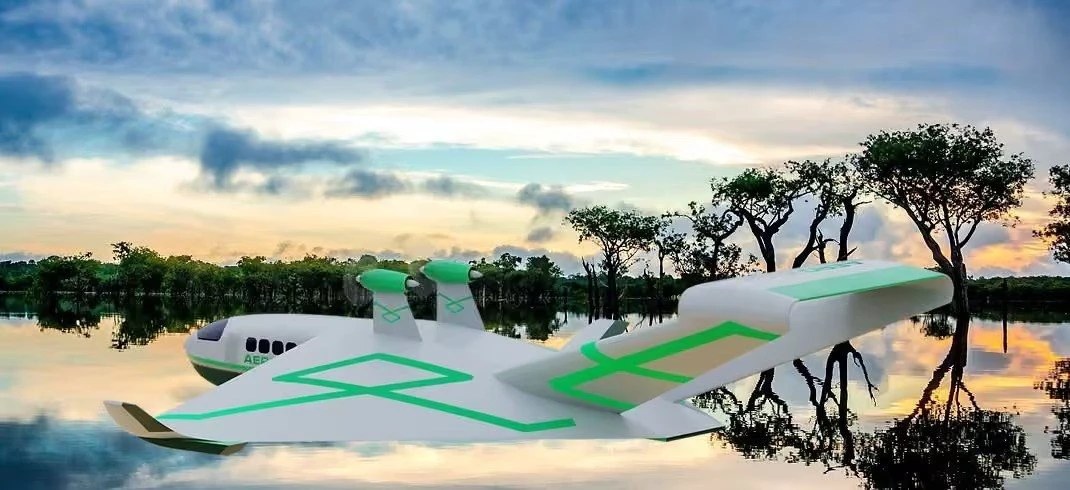
There is a category of vehicle that never quite fitted anywhere. It is not a boat, because it leaves the water. It is not a plane, because it does not climb. It flies a few metres above the surface, resting on a cushion of air created by its own movement.
It is called ground effect, and the idea is not new. The Soviets built enormous ekranoplans on the Caspian Sea during the Cold War, machines that impressed everyone and never became a business.
What has changed now is the problem. A startup from Manaus, AeroRiver, took that old principle and pointed it at a very concrete Brazilian question: how do you cross the Amazon when there is no road.
The river is the highway, and it is slow
Across most of the Amazon, transport is fluvial because there is no alternative. A regional boat is cheap, carries many people and a lot of cargo, but takes the time it takes.
The stretch between Manaus and Parintins is the example the company itself uses. Today it takes around ten hours by boat. The fast alternative is a plane, which requires an airport at both ends, expensive infrastructure and a scale of demand that many riverside towns simply do not have.
That is exactly the gap a ground-effect craft tries to fill. It takes off and lands on the water itself, needs no runway and uses as infrastructure something the region has in abundance: river.
How flying two metres up works
The principle is aerodynamic. When a wing travels very close to a surface, the air compressed between it and the ground, or the water, creates additional lift and reduces induced drag.
In practice, a wing is more efficient near the ground than far from it. It is the same effect any pilot feels in the last metres of a landing, when the aircraft seems to float before touching down.
The ground-effect craft turns that fleeting moment into a permanent operating regime. According to AeroRiver, the vehicle works between two and five metres above the surface, at a cruising speed of 150 km/h.
The economic consequence is the central point. Flying in that band, fuel consumption sits well below that of a conventional aircraft at the same speed, because part of the lift comes for free.
What the company is presenting
AeroRiver is developing more than one vehicle. The Volitan is the crewed one, described by the company as pre-operational, with the first units in preparation and already available to order. The Voadeiro is an uncrewed ground-effect drone, aimed at monitoring, light logistics and security missions. There is also the Stingray platform.
The published configuration for the crewed vehicle allows up to ten passengers or one tonne of cargo, with hybrid propulsion combining a combustion engine with electric motors for take-off, and reported consumption of seven to eight kilometres per litre.
The company says it has gathered more than fifty letters of intent, corresponding to more than sixty vehicles. The first crewed tests are scheduled for between December 2026 and February 2027.
Production is split between Manaus and São José dos Campos, in the interior of São Paulo state, with final assembly in Manaus. That choice says something relevant: São José dos Campos is the Brazilian aeronautical hub, and the project leans on that technical base.
The numbers the company promises
In the comparisons published by AeroRiver, the vehicle would be ten times faster than conventional river transport and around 40% more efficient than traditional aviation.
These are manufacturer figures, not yet confirmed in commercial operation, and it is fair to treat them as what they are: a technical promise that the crewed tests will validate or correct.
But the order of magnitude is what matters here. Even if reality lands below the brochure, a vehicle that turns ten hours into three on a regional route changes the economic life of everyone who depends on it.
The challenge is not only engineering
There is a difficulty that has followed ground effect from the start, and it does not lie in aerodynamics.
A craft travelling just above the water sits between two regulatory worlds that almost never speak to each other: maritime and aeronautical. Who certifies it, under which rules, with what crew licensing, under which traffic rules on a busy river.
That has historically been the sector’s biggest barrier, harder to overcome than the design of the hull and the wing itself. Watching how AeroRiver crosses that ground is as interesting as watching the machine perform.
Why this matters to the Ocean Economy
It is tempting to see AeroRiver as an Amazonian curiosity. That would be a mistake.
The ground-effect craft sits exactly on the frontier between naval and aeronautical engineering. A hull that must withstand water impact, an aircraft-light structure, hydrodynamics on take-off, aerodynamics in cruise, hybrid propulsion, composite materials and electronic control. It is almost a summary of the Ocean Economy axes inside a single project.
And the problem it attacks is not exclusive to the Amazon. Indented coastlines, islands, bays, coastal lagoons and reservoirs face the same equation: boats too slow, airports too expensive.
It is also worth noting where the innovation is coming from. Not from a large European shipyard nor an Asian manufacturer. From a startup in Manaus attacking a Brazilian logistics problem with Brazilian engineering.
Innovation is born of constraint
Blue Tech Radar follows technologies transforming the Ocean Economy. Many of them are born precisely where infrastructure is missing.
The Amazon has no roads, so it invents a vehicle that uses the river as a runway. It is the same reasoning that led Brazil to develop regional aviation and tropical agriculture: the constraint became the speciality.
If the Volitan flies as promised, Brazil will have developed an exportable water mobility solution for dozens of countries with similar geography. If it does not, it will still have trained engineers, suppliers and a supply chain around a frontier technology.
In either scenario, it is worth watching closely.
Blue Tech | AeroRiver in numbers
Crewed vehicle: Volitan, at pre-operational stage. Operating height: 2 to 5 metres above the surface. Cruising speed: 150 km/h. Capacity: up to 10 passengers or 1 tonne of cargo. Propulsion: hybrid, with a combustion engine and electric motors for take-off. Reported consumption: 7 to 8 km per litre. Reference route: Manaus to Parintins, from around 10 hours to approximately 3. Crewed tests scheduled: December 2026 to February 2027. Production: Manaus and São José dos Campos, with final assembly in Manaus. Letters of intent: more than 50, for more than 60 vehicles.
Blue Nautical Hub Brasil report, with information from AeroRiver. Image: AeroRiver. The performance data are those published by the company and have not yet been verified in commercial operation.